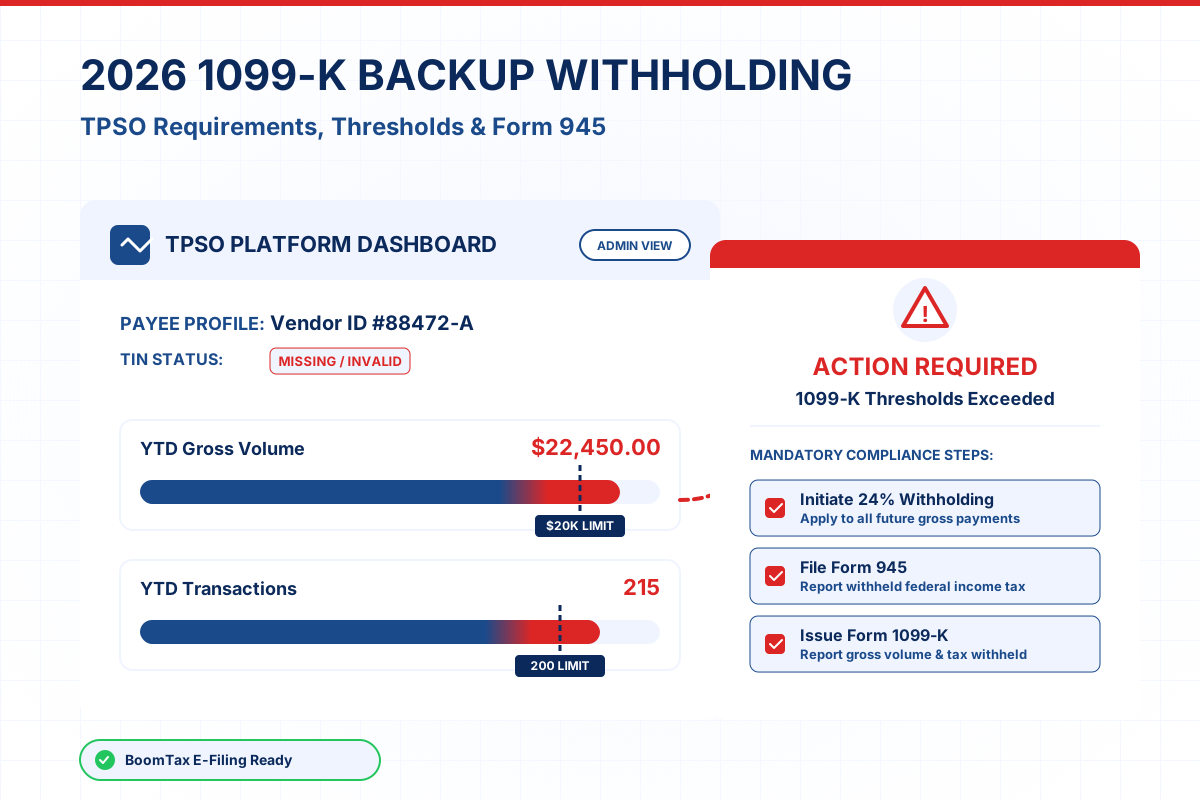
If your platform files Form 1099-K, the IRS just gave third party settlement organizations a clearer backup withholding rule: for third party network transactions, backup withholding now follows the familiar more than 200 transactions and more than $20,000 Form 1099-K de minimis threshold.
On August 10, 2026, the IRS and Treasury published final regulations TD 10053, Backup Withholding on Third Party Network Transactions, in the Federal Register. The regulations finalize proposed regulations REG-112829-25, published on January 9, 2026, and adopt them without change. You can review the government source text.
For businesses that operate payment platforms, marketplaces, gig economy networks, creator platforms, or similar third party networks, this update matters because it changes when a payment becomes a reportable payment for IRC §3406 backup withholding purposes. It also affects when withheld federal income tax must be captured for Form 945, Annual Return of Withheld Federal Income Tax.
Introduction — What Happened and Why It Matters for 1099-K Filers
IRS final regulations TD 10053 issued for TPSO backup withholding
TD 10053 updates the employment tax regulations in 26 CFR Part 31 under Internal Revenue Code §3406. That Code section governs backup withholding on reportable payments when a withholding condition exists, such as a missing or incorrect taxpayer identification number.
The regulations were issued under the authority of IRC §3406(i), which allows Treasury to prescribe regulations needed to carry out §3406, and IRC §7805(a), which authorizes Treasury to issue rules and regulations for enforcing the Internal Revenue Code.
Why 1099-K backup withholding rules changed
The final regulations reflect statutory changes made by section 70432(b)(1) of Public Law 119-21, commonly known as the One, Big, Beautiful Bill Act, enacted on July 4, 2025. That statutory change amended IRC §3406 to align backup withholding for third party network transactions with the Form 1099-K de minimis threshold under IRC §6050W(e).
In practical terms, the IRS removed regulatory language that conflicted with the updated statute. The final regulations explain that, for third party network transactions, the amount subject to backup withholding is determined with regard to the same de minimis exception that applies for TPSO Form 1099-K reporting.
Bottom line for third party settlement organizations
For third party settlement organizations, or TPSOs, backup withholding generally applies to third party network transactions only after the participating payee exceeds both of these thresholds during the calendar year:
- More than 200 transactions, under IRC §6050W(e)(2); and
- More than $20,000 in aggregate gross payments, under IRC §6050W(e)(1).
The final regulations are effective August 10, 2026, but their applicability date reaches back to payments made in calendar years beginning after December 31, 2024. That means the rule applies starting with calendar year 2025 payments.
What Does This Mean for 1099 Filers?
TPSOs must align backup withholding with Form 1099-K reporting thresholds
For Form 1099-K filers that are TPSOs, TD 10053 clarifies that the amount subject to backup withholding under IRC §3406 is the amount subject to reporting under IRC §6050W. For third party network transactions, a payment is treated as a reportable payment only if the participating payee exceeds both parts of the IRC §6050W(e) threshold.
The rule is measured per participating payee, not merely per account. TD 10053 notes that the threshold applies with respect to each participating payee as defined in IRC §6050W(d)(1). The regulations also reference the participating payee definition in Treas. Reg. §1.6050W-1(a)(5)(i)(B).
Form 1099-K is the primary information return affected
The main information return affected is Form 1099-K, Payment Card and Third Party Network Transactions. TPSOs that file Form 1099-K should review their threshold monitoring, TIN solicitation, withholding, and year-end reporting workflows.
If your organization is looking for a streamlined way to manage information return filing, BoomTax supports electronic filing for 1099 forms, including common year-end filing needs.
Other 1099, W-2, W-2G, and ACA forms are not directly changed
TD 10053 is focused on backup withholding for payment card and third party network transactions under IRC §3406 and IRC §6050W. It does not directly change filing rules for:
- Form 1099-NEC for nonemployee compensation;
- Form 1099-MISC for miscellaneous payments such as rents or royalties;
- Form W-2 for wages;
- Form W-2G for certain gambling winnings;
- Form 1095-B or Form 1095-C for ACA reporting.
Likewise, payments reportable under other Code sections, such as IRC §6041 for certain information returns, remain subject to their own reporting and backup withholding rules. TD 10053 does not rewrite those separate regimes.
Key Details / What Changed
Backup withholding now follows the IRC §6050W(e) de minimis threshold
Before these final regulations, the rules created confusion because the backup withholding regulations for third party network transactions did not fully align with the statutory Form 1099-K de minimis reporting threshold. TD 10053 addresses that mismatch by revising Treas. Reg. §31.3406(b)(3)-5(b).
After the change, Treas. Reg. §31.3406(b)(3)-5(b)(2) provides that the amount subject to withholding under §3406 is determined with regard to the exception for de minimis payments by TPSOs in IRC §6050W(e).
The applicable threshold is more than 200 transactions and more than $20,000
The threshold is not “200 or $20,000.” Both tests must be exceeded. A third party network transaction becomes a reportable payment for backup withholding purposes only if, during the calendar year, the aggregate number of transactions with respect to the participating payee exceeds the number in §6050W(e)(2) and the aggregate amount of reportable payment transactions exceeds the dollar amount in §6050W(e)(1).
In the regulations, those amounts are applied as more than 200 transactions and more than $20,000 in gross payments for the participating payee.
Withholding begins on the transaction that causes the later threshold to be exceeded
One of the most operationally important details is timing. If a backup withholding condition exists, the TPSO does not simply withhold on the next payment after year-end. The regulations state that the amount subject to withholding is the entire amount of the transaction that causes the relevant threshold to be exceeded, based on whichever threshold is crossed later.
That means a TPSO must identify the exact transaction where both thresholds have been exceeded. After that point, the TPSO must backup withhold on subsequent third party network transaction payments to that participating payee during the same calendar year if a withholding condition exists.
Backup withholding rate is tied to IRC §3406 and IRC §1(c)
Under Treas. Reg. §31.3406(a)-1(a), a payor must deduct and withhold an amount equal to the product of the fourth lowest rate of tax applicable under IRC §1(c) and the reportable payment if a condition for withholding exists. This backup withholding rate is commonly 24%.
Common backup withholding triggers include a payee failing to provide a taxpayer identification number or providing information that results in a mismatch. This is why strong W-9 form collection and TIN validation processes remain essential for TPSOs.
Regulatory examples show how the threshold works
TD 10053 includes several examples involving Platform A, a TPSO, and Y, a participating payee. In the first example, A properly solicits a TIN from Y, but Y does not provide one. During calendar year 2026, A makes 201 payments in settlement of third party network transactions totaling $20,000.01.
Because the 201st transaction causes Y to exceed both the 200-transaction and $20,000 thresholds, A must backup withhold on the entire amount of that 201st transaction.
Prior-year reportable payment rule can require withholding in a later year
The final regulations also include an important carryover rule in Treas. Reg. §31.3406(b)(3)-5(b)(3). The de minimis threshold rule does not apply for a participating payee in a calendar year if one or more payments in settlement of third party network transactions made by the payor to that payee during the preceding calendar year were reportable payments.
That rule can require backup withholding even when the current year’s activity is below the more-than-200 and more-than-$20,000 thresholds.
- 2027 example: If Platform A made reportable payments to Y in 2026, then in 2027 A must backup withhold on each third party network transaction payment to Y, even if 2027 activity is only 199 payments totaling $18,000.
- 2028 example: If 2027 payments to Y were reportable because of the prior-year rule, then in 2028 A must backup withhold on each payment to Y, even if 2028 activity is only four payments totaling $2,000.
- 2030 example: If A makes no third party network transaction payments to Y in 2029, and then makes 199 payments totaling $18,000 in 2030, A is not required to backup withhold in 2030 because there were no reportable payments to Y in the preceding calendar year and Y did not exceed the de minimis threshold in 2030.
For TPSOs, this means the system cannot look only at current-year volume. It must also know whether the payee had reportable third party network transaction payments in the immediately preceding calendar year.
Form 945 Implications for 1099-K Backup Withholding
Backup withholding is reported on Form 945
Federal income tax withheld under the 1099-K backup withholding rules is reported on Form 945, Annual Return of Withheld Federal Income Tax. TD 10053 specifically identifies the Form 945 and its instructions as the collection of information associated with backup withholding under Treas. Reg. §31.3406(b)(3)-5.
The Paperwork Reduction Act discussion in the final regulations states that the Form 945 information collection is approved under OMB control number 1545-0029. It also notes that the Form 945 burden is included with the Form 945 and instructions, and the related burden estimates are included in the estimates shown in the Instructions for Form 941.
TPSOs need year-to-date threshold tracking
Because withholding may begin on the exact transaction that causes the later threshold to be exceeded, TPSOs should track both transaction count and gross payment amount throughout the calendar year. Waiting until year-end creates risk because the withholding obligation may have started during the year.
At a minimum, TPSO systems should be able to track:
- Aggregate transaction count by participating payee;
- Aggregate gross payments by participating payee;
- The transaction that causes the payee to exceed 200 transactions;
- The transaction that causes the payee to exceed $20,000;
- Whether a backup withholding condition exists, such as a missing TIN;
- Whether the payee had reportable payments in the prior calendar year.
Recordkeeping and information reporting burdens
The IRS certified that the final regulations will not have a significant economic impact on a substantial number of small entities. The reason is practical: TD 10053 does not impose new requirements. Instead, it clarifies the threshold at which entities are required to backup withhold, and the IRS stated that increasing the threshold should reduce how often TPSOs must backup withhold.
Still, “reduced frequency” does not mean “no compliance work.” TPSOs should coordinate Form 1099-K reporting data, backup withholding records, TIN solicitation records, deposit processes, and Form 945 filing workflows.
Timeline / Deadlines
Key dates from TD 10053
The final regulations include several dates TPSOs should know. The rule was published in 2026, but its applicability date reaches back to calendar year 2025 payments because it mirrors the effective date Congress provided in Public Law 119-21.
- July 4, 2025: Public Law 119-21, the One, Big, Beautiful Bill Act, was enacted. Section 70432(b)(1) amended IRC §3406.
- January 9, 2026: Treasury and the IRS published proposed regulations REG-112829-25 in the Federal Register at 91 FR 934.
- August 10, 2026: Treasury and the IRS published final regulations TD 10053 in the Federal Register at 91 FR 51391-51395.
- August 10, 2026: TD 10053 became effective.
- Calendar years beginning after December 31, 2024: The final regulations apply to payments made in these calendar years, meaning 2025 and later payments are covered.
Annual Form 1099-K and Form 945 filing considerations
For a 2026 calendar-year Form 1099-K cycle, TPSOs should apply the more-than-200-transactions and more-than-$20,000 threshold when determining whether third party network transaction payments become reportable payments for backup withholding purposes.
Form 1099-K is generally furnished and filed after the close of the calendar year, while Form 945 is used to report backup withholding for the year. TPSOs should review IRS instructions for the applicable year because filing deadlines, deposit obligations, electronic filing requirements, and calendar timing can vary.
BoomTax maintains deadline resources for common information return filing obligations, including 2026 deadlines for 1095, 1099, W-2, 940, and 941 forms.
Who Is Affected?
Third party settlement organizations
The primary affected filers are third party settlement organizations that make payments in settlement of third party network transactions. The final regulations reference TPSOs as defined in Treas. Reg. §1.6050W-1(c)(2).
Affected organizations may include payment apps, online marketplaces, creator platforms, gig platforms, and other third party networks responsible for Form 1099-K reporting.
Participating payees
Participating payees are affected because backup withholding may apply when a payee does not provide a TIN, provides an incorrect TIN, or otherwise triggers a backup withholding condition under IRC §3406. The IRS also emphasized that the threshold applies with respect to each participating payee, which matters when a TPSO maintains multiple accounts with identical TINs, identical identifying information, or indicators of common beneficial ownership.
Businesses filing other information returns
Businesses filing Form 1099-NEC, Form 1099-MISC, Form W-2, Form W-2G, Form 1095-B, or Form 1095-C are not directly affected by TD 10053 unless they also operate as TPSOs filing Form 1099-K.
The final regulations do not change backup withholding rules for other reportable payments, such as interest, dividends, nonemployee compensation, rents, royalties, or other payments covered by separate reporting provisions like IRC §6041.
What to Do Next / How TPSOs Should Prepare
Update Form 1099-K threshold logic
TPSOs should update internal 1099-K backup withholding systems to apply the more-than-200-transactions and more-than-$20,000 gross-payment threshold for third party network transaction payments. Systems should identify the later of the two threshold-crossing events because withholding begins on the entire transaction that causes the later threshold to be exceeded.
Strengthen TIN collection and solicitation procedures
Backup withholding generally becomes relevant when a withholding condition exists. That means TIN collection and documentation are still central to compliance. TPSOs should document TIN solicitation processes so they can support withholding decisions when a participating payee fails to provide required information.
Build prior-year reportable payment tracking
The prior-year reportable payment rule is easy to miss. If one or more payments to the participating payee were reportable payments in the preceding calendar year, the de minimis threshold exception does not apply for that payee in the current year.
That means a TPSO should create reports that identify payees with reportable payments in the immediately prior year. Without this data, the platform may incorrectly wait for the current-year threshold to be exceeded.
Prepare Form 945 workflows
Coordinate Form 1099-K reporting and Form 945 backup withholding reporting so withheld amounts are captured, deposited if required, and reported accurately. Form 945 is separate from Form 941, Employer’s Quarterly Federal Tax Return; backup withholding is generally reported on Form 945 rather than Form 941.
FAQ
What is 1099-K backup withholding?
1099-K backup withholding is federal income tax withholding under IRC §3406 on reportable payment card or third party network transaction payments when a backup withholding condition exists, such as a missing taxpayer identification number.
What is the 2026 TPSO backup withholding threshold?
For TPSO third party network transactions, the threshold is more than 200 transactions and more than $20,000 in gross payments to a participating payee during the calendar year. This matches the IRC §6050W(e) de minimis threshold for Form 1099-K reporting by TPSOs.
When does a TPSO start withholding?
If a backup withholding condition exists, the TPSO starts withholding on the entire transaction that causes the participating payee to exceed both thresholds, measured by whichever threshold is crossed later. The TPSO then withholds on later third party network transaction payments to that participating payee during the calendar year.
What is the prior-year reportable payment rule?
Under Treas. Reg. §31.3406(b)(3)-5(b)(3), if the TPSO made one or more reportable third party network transaction payments to the payee in the prior calendar year, the de minimis threshold exception does not apply for that payee in the current calendar year.
Does no Form 1099-K mean the income is not taxable?
No. The IRS stated in TD 10053 that the taxability of payments and the requirement to report income on an income tax return are not determined by whether the taxpayer receives Form 1099-K or whether backup withholding applies.
Conclusion — Stay Ready for 1099-K Filing and Backup Withholding
TD 10053 gives TPSOs a clearer rule: backup withholding under IRC §3406 for third party network transactions is aligned with the IRC §6050W Form 1099-K de minimis threshold of more than 200 transactions and more than $20,000 per participating payee.
The final regulations are effective August 10, 2026, and apply to payments made in calendar years beginning after December 31, 2024. TPSOs should focus on payee-level aggregation, TIN solicitation, threshold monitoring, prior-year reportable payment tracking, and Form 945 reporting.
BoomTax helps businesses e-file Form 1099-K, Form 1099-NEC, Form 1099-MISC, W-2, and ACA forms. When you are ready to streamline year-end reporting, explore BoomTax 1099 e-filing tools to simplify preparation, filing, and compliance.
BoomTax, The Boom Post, and its affiliates do not provide tax, legal or accounting advice. This material has been prepared for informational purposes only, and is not intended to provide, and should not be relied on for, tax, legal or accounting advice. You should consult your own tax, legal and accounting advisors prior to engaging in any transaction.
About Author