Waiting until the last minute to file year-end forms might be common, but it is rarely the best strategy. If you want fewer errors, less stress, and a smoother experience for your employees and contractors, filing 1099 and W-2 forms early gives you a major advantage.
Every year, employers and businesses scramble to prepare wage and information returns for employees and contractors. While the law sets firm deadlines, the smartest move is to start and finish well before the due dates.
This guide explains why filing early pays off, what risks you avoid by not waiting, and how to build a practical timeline that works for organizations of all sizes.
Who Needs to File W-2s and 1099s—and When
In general, employers must furnish Form W-2 to employees and file with the Social Security Administration (SSA). Businesses that pay nonemployees, such as independent contractors, generally must furnish Form 1099-NEC and file with the IRS.
Other 1099 series forms, including 1099-MISC, 1099-INT, and 1099-DIV, may also be required depending on the payments you made. If you need a broader overview, see BoomTax’s 1099 forms and W-2 forms resources.
- January 31: Furnish W-2s to employees and 1099-NEC to contractors; file W-2 with SSA and 1099-NEC with IRS.
- February 28 (paper) / March 31 (e-file): Most other 1099s are due to the IRS. Recipient due dates are often January 31, with some exceptions like 1099-B and certain brokerage statements typically due to recipients by mid-February.
- E-file requirement: If you are filing 10 or more returns in total, aggregated across many types, you generally must e-file.
State deadlines and filing rules vary. Many states require separate filing or participation in combined federal/state programs, so you should verify your state’s requirements separately.
For official IRS guidance, review About Form W-2, About Form 1099-NEC, and General Instructions for Certain Information Returns.
The Compounding Benefits of Filing Early
Filing on or before the deadline is compliant, but it is not always optimal. The advantages of filing 1099 and W-2 forms early compound across accuracy, cost, time, and risk management.
- More time to fix mistakes: Early submission exposes formatting errors, TIN mismatches, or rejected transmissions while there is still breathing room to correct and refile.
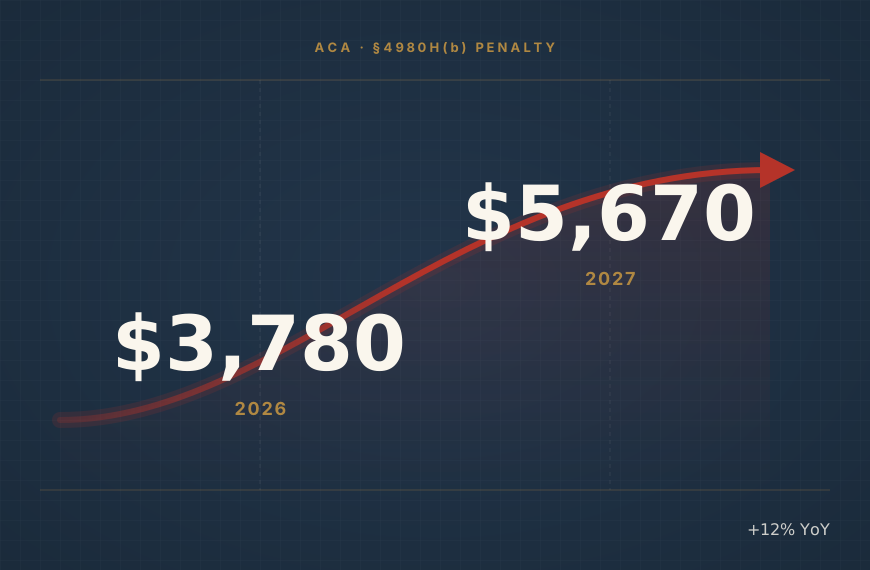
- Lower penalty risk: Late or incorrect filings can trigger penalties per return that escalate the later you file, and amounts are adjusted annually for inflation. Early action reduces the chance of missing deadlines or making rushed errors. You can also review BoomTax’s guide to 1099 penalties.
- Better recipient experience: Employees and contractors rely on these forms to file their own returns. Early, accurate forms help them avoid delays and amended returns.
- Stronger fraud defense: Submitting W-2 and 1099 data early can help tax authorities match returns promptly, reducing the window for identity theft or fraudulent filings.
- Operational sanity: January can be chaotic. Early prep evens out workloads, shortens queues for support teams, and improves cross-department coordination.
- Cash flow visibility: Reconciling year-end payroll and contractor payments sooner provides a clearer financial picture for the new year’s planning.
The Hidden Risks of Waiting Until Deadline Day
- System bottlenecks: Filing portals, payroll systems, and vendor support lines get slammed near deadlines, increasing the chance of delays and stress.
- Compressed correction window: If a batch is rejected on deadline day, you may not have enough time to correct and retransmit.
- Higher error rates: Rushed data entry, last-minute changes, and incomplete W-9 or W-4 information lead to avoidable mistakes.
- Recipient dissatisfaction: Late or incorrect statements can harm trust with employees and contractors and create extra work for your team.
Two Quick Examples
Example 1: Early Filing Avoids a Penalty Spiral
A design studio prepares W-2s and 1099-NECs by mid-January. During a test validation, they discover three TIN mismatches. They collect updated W-9s and resubmit within two days.
Everyone receives accurate forms by January 25, and the filings are accepted on the first try—no penalties, no frantic emails, and minimal support tickets.
Example 2: Deadline-Day Rejection
A contractor-heavy startup waits until January 31 to file. Their 1099-NEC batch is rejected at 8:30 p.m. due to a formatting error.
Support channels are overloaded, time runs out, and the company misses the deadline. Penalties apply per return, and several recipients file their own taxes using incorrect data, creating a second wave of corrections and frustration.
Actionable Checklist: How to Prepare Early
- Collect and verify tax information now: Ensure you have current W-4s for employees and W-9s for contractors. Validate names and TINs, and use the IRS TIN Matching program if eligible.
- Reconcile payments monthly or quarterly: Tie out payroll and contractor ledgers to 941s, 944s, or internal records. Spot anomalies before year-end.
- Confirm worker classifications: Review who is an employee versus independent contractor to avoid misclassification issues.
- Set internal deadlines: For example, require all address and name updates by January 10 and all final payment adjustments by January 12.
- Test small batches if your system allows: Catch formatting or schema errors early, especially if you changed software.
- Plan for corrections: Establish a process for issuing Form W-2c or corrected 1099s. Early filing gives you time to correct without panic. If needed, BoomTax also offers guidance on filing 1099 corrections.
- Protect against phishing and fraud: Train staff to verify unusual requests for W-2 or 1099 data, and use secure portals instead of email for sensitive files.
- Document everything: Keep date-stamped records of filings, acknowledgments, and recipient communications.
A Practical Timeline (October–March)
A simple timeline can make year-end reporting much more manageable. Here is a practical schedule you can adapt for your organization.
Common Pitfalls and How to Avoid Them
- Name/TIN mismatches: Use IRS TIN matching early and ensure legal names match SSA or IRS records.
- Incorrect addresses or former workers: Use the last known address, encourage updates before year-end, and consider electronic delivery with consent.
- Wrong box codes on 1099s: Review instructions for 1099-NEC versus 1099-MISC, and avoid duplicating amounts.
- Missing state filings: Confirm whether your state requires separate submissions or supports combined federal/state filing.
- Overlooking the e-file mandate: If you file 10 or more returns in aggregate, e-file is generally required. If you are filing electronically, BoomTax’s e-file Form 1099-NEC online resource may help.
Quick FAQs
What if I discover an error after I file?
File a corrected return using Form W-2c for employees or a corrected 1099 for contractors. Early filing helps you find and fix issues before recipients file their own taxes.
Are there penalties for small dollar errors?
There is a de minimis safe harbor for small dollar errors in certain cases, but recipients can still request a correction. It is best to aim for accuracy the first time.
Should I e-file or paper file?
E-file is faster, reduces manual errors, and provides quicker acknowledgments. It is also required for many filers who meet the 10-return threshold across aggregated forms.
Why “Early” Beats “On Time”
Being technically on time might still leave you exposed to rejections, corrections, and support overload. The real advantage comes from filing 1099 and W-2 forms early, when you can calmly address issues, communicate with recipients, and reduce penalty exposure.
Think of early filing as insurance for your compliance process. For small businesses without dedicated payroll teams, filing 1099 and W-2 forms early spreads the workload and limits last-minute surprises. Larger organizations benefit from improved audit trails, more manageable approval cycles, and better quality assurance.
Helpful Resources
- IRS General Instructions for Certain Information Returns
- Instructions for Forms W-2 and W-3
- IRS TIN Matching Program
- Your state’s Department of Revenue website for state-specific rules
- BoomTax deadline guide: 2026 deadline for 1095, 1099, W-2, 940, and 941 forms
Bottom Line
If you want fewer headaches in January, start now. Build a simple plan, set early internal due dates, validate data, and submit before the rush.
The benefits of filing 1099 and W-2 forms early–from fewer rejections to better relationships with employees and contractors–far outweigh the effort to get ahead of the calendar. In short, filing 1099 and W-2 forms early is one of the easiest ways to protect your organization from avoidable risk and stress.
BoomTax, The Boom Post, and its affiliates do not provide tax, legal or accounting advice. This material has been prepared for informational purposes only, and is not intended to provide, and should not be relied on for, tax, legal or accounting advice. You should consult your own tax, legal and accounting advisors prior to engaging in any transaction.
About Author